Manifesta originated in the early 1990’s in response to the political, economic and social changes following the end of the Cold War and the subsequent steps towards European integration. Since that time, Manifesta has developed into a traveling platform focusing on the dialogue between art and society in Europe.
Education and Mediation
The Nomadic nature of Manifesta enables a unique encounter between home-based and international citizens. They come from diverse cultures, professional backgrounds, and life experiences.
The Education and Mediation programme aims to establish a space where all these diversities are valued and shared. A space where we all learn, and not teach. Its goal is to engage with and learning from the existing (self-organised) initiatives in order to create a biennial programme where more people can recognise themselves.
School Projects
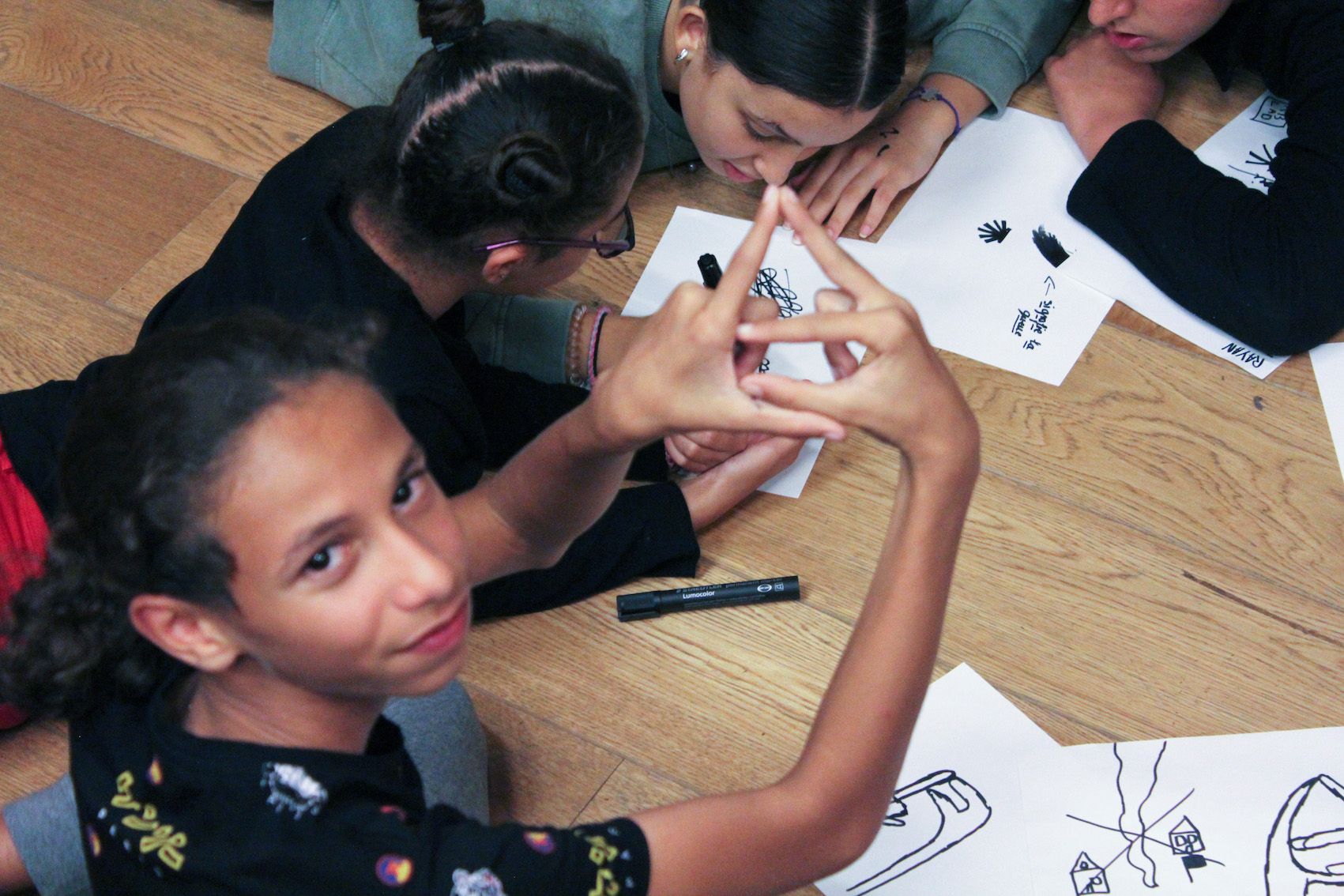
Formal education is an important social institute, that forms our society, its values, social behaviour, and cultural norms. In each Manifesta edition we investigate in what way artistic and/or critical pedagogical practices can contribute to the curricular of primary, secondary, or high schools. Projects are focused on exploring subjective gaps in the curricular and/or teaching methods and offer proposals for tackling them. These proposals are results of collaboration between students, teachers and schools’ management, guest artists/educators and Manifesta’s Education team.
![]()
![]()
![]()
![]() Manifesta 14 Prishtina: Uncover your Story: a manual to local culture
Manifesta 14 Prishtina: Uncover your Story: a manual to local cultureAs the pre-biennial Urban Vision of CRA showed, Prishtina is often perceived as a spatially fragmented city with little to no social contact between the neighbourhoods.
Manifesta Mediators
Mediation programme of Manifesta offers different ways to welcome and to engage with our diverse public. It is a collective encounter that involves treating each other as owners of authentic experiences and cultures. This opposes the common idea of transferring “objective” knowledge or opinion from a more informed guide to a less informed audience.
Community projects
The Community programme of Manifesta follows the mediation approach. Following the findings of the pre-biennial urban research and citizens’ consultations, it aims at engaging with the existing practices and knowledges of communities and offering space and support for their development in dialogue with the project of Manifesta.
Community-driven programmes requires time, safe environment, creative independency and openness to unexpected outcomes. In recent editions we put significant resources in community programmes, setting up physical spaces and facilitating collective projects with shared agency. The outcome of community programmes cannot be pre-defined, it goes beyond institutional categories and disciplinary divisions and can be described as educational, curatorial, research or artistic, but always developed in a collective process.
![]()
![]()
![]() Manifesta 12 Palermo: Un Grande Giardino
Manifesta 12 Palermo: Un Grande GiardinoThe most ambitious and challenging persuits of Manifesta lie in the realm of urban commons of the host city. The path to commons consciousness in Palermo is very twisted, but no cultural initiative can develop successfully and meaningfully there without …
Education and Community spaces
![]()
![]()
![]() Manifesta 13 Marseille: Tiers QG
Manifesta 13 Marseille: Tiers QGTiers QG, the headquarters of Le Tiers Programme (Third Programme), was the first space Manifesta 13 opened to public almost a year before the official opening of the biennial in Marseille.
Publications
![]()
![]()
![]() Manifesta 14 Prishtina: Mapping Subculture Movements
Manifesta 14 Prishtina: Mapping Subculture MovementsTo understand Prishtina’s pre-existing cultural ecosystem, especially outside of that which is supported and endorsed by institutions, Manifesta 14’s Education and Mediation Department in collaboration with the community centre Termokiss, initiated a research project which attempted to map and trace …




Un Grande Giardino
The most ambitious and challenging persuits of Manifesta lie in the realm of urban commons of the host city. The path to commons consciousness in Palermo is very twisted, but no cultural initiative can develop successfully and meaningfully there without participating in social interactions and situating ourselves in relation to the community. Part of Manifesta 12 Community programme concentrated on the neighbourhood ZEN2, the area of artistic intervention of Manifesta 12 participants Gilles Clément and Coloco.
ZEN (Zona Espansione Nord) is a social housing district located in the northern outskirts of Palermo, re-named San Filippo Neri in the nineties, and divided in two well-defined areas, ZEN1 and ZEN2. ZEN2 was constructed in 1969, designed by Italian architect Vittorio Gregotti. The project was inspired by the idea of the walled city and is organised in blocks of so-called insulas. The political situation between 1975 and 1980 disrupted the overall transformation of the neighbourhood and left ZEN2 without services and various infrastructure. Furthermore, due to an extreme housing shortage, squatting in these buildings became common. These factors created a complex social environment and resulted in the degradation of the area.


The Education Department devised a programme for children and families in order to support Gilles Clement and Colocoâs artistic project in the neighbourhood of ZEN.
It was all about taking time, that artistic projects often lack. We took time for getting to know each other, learning about how neighbours used to share communal space and the ideas and the needs the have had. The workshops were partly led by home-based collectives of artists and activists known for their participatory practices, such as Studio Pica, Orto Capovolto, and Teatro degli Spiriti. Some of them continued collaboration with Zen Insieme beyond Manifesta 12.
The programme played an essential role in situating the artistic intervention and the transformation process within the community, not only through workshops, but more importantly by providing space for social gatherings where we all spent time together and were getting used to share a new common space.


Community gardening workshops by Orto Capovolto in the pre-biennial programme.